
Discover More On:
Why Is My Car Losing Power Going Uphill or Merging?
Browse by Repair
A car losing power uphill or during a highway merge may have a problem with fuel, air, spark, exhaust flow, turbo boost, or the transmission. The extra load exposes faults that may stay hidden during easy, level driving. Our engine diagnostics process tests the vehicle under the conditions that trigger the symptom instead of treating a code as a final answer.
For Orange Park drivers, the problem may show up on the Buckman Bridge, an I-295 entrance ramp, or a loaded trip along U.S. 17.
Why a Car Loses Power Under Load
A vehicle needs more fuel, airflow, ignition strength, and torque when it climbs or accelerates into traffic. A weak component may keep up at light throttle but fall short as demand rises. This pattern is called loss of power under load.
The engine computer may reduce output when it detects a serious fault. A scan gives useful data, but system tests may still be needed.
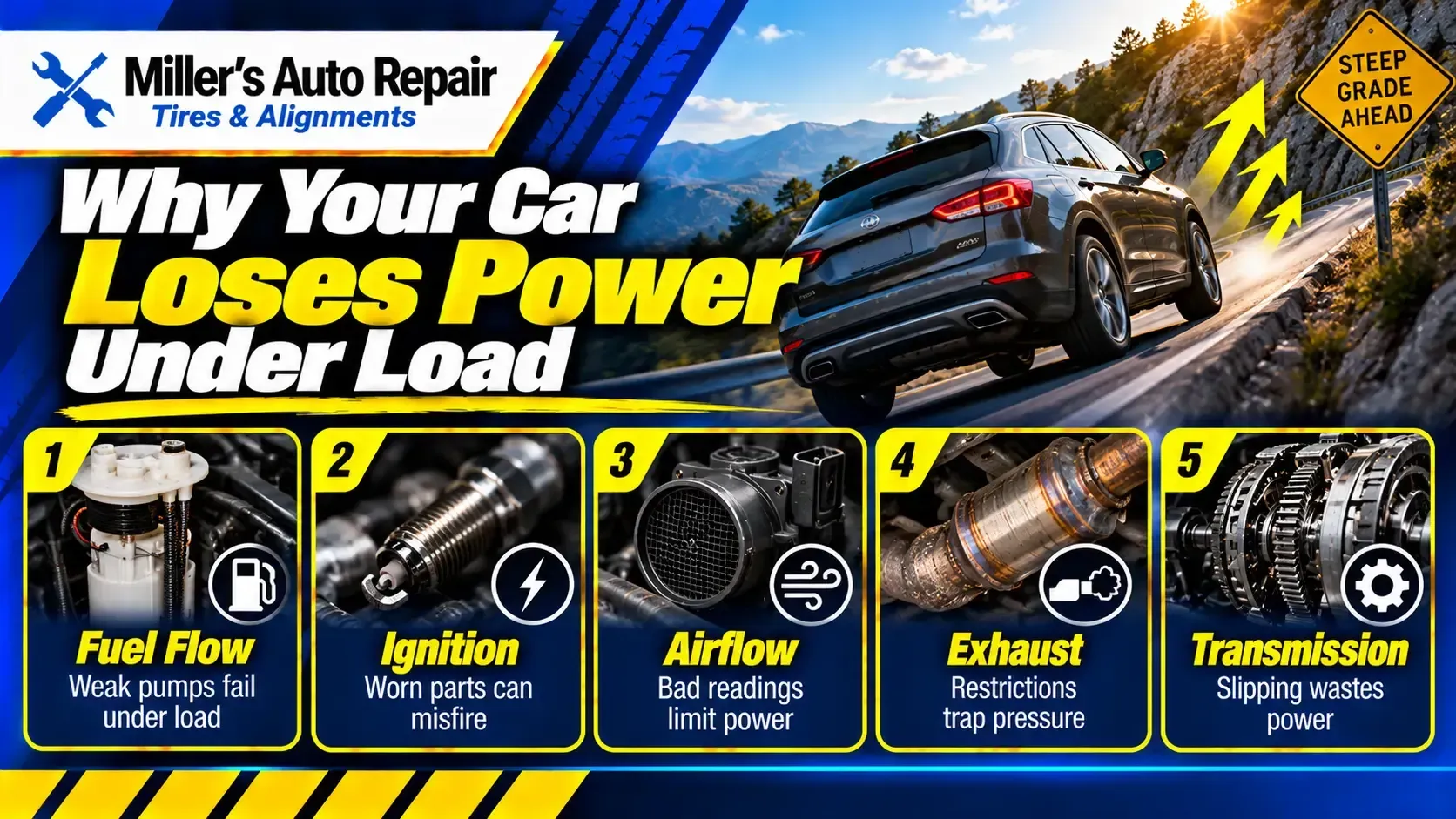
Common Causes of Power Loss
The most common causes affect fuel delivery, ignition, airflow, exhaust flow, boost, or power transfer. Because several faults feel alike, parts should be tested before they are replaced.
Restricted Fuel Delivery
A weak fuel pump, restricted filter, or dirty injector can supply enough fuel at idle but not during a climb. The engine may hesitate, surge, or feel as if the accelerator has stopped responding. A fuel system repair visit can compare commanded fuel data with actual pressure and volume under load.
Florida heat can make a worn pump act worse after the vehicle has been running.
Weak Ignition or Airflow Control
Worn spark plugs and weak ignition coils can misfire when cylinder pressure rises under acceleration. A dirty mass airflow sensor, throttle problem, vacuum leak, or inaccurate pressure sensor can also upset the fuel mixture. If your car loses power when accelerating, a flashing check engine light or shaking engine makes an active misfire more likely.
Testing may include misfire counter readings, fuel trims, sensor data, and ignition waveform testing.
Exhaust Restriction or Boost Loss
A restricted catalytic converter can trap exhaust and limit how quickly the engine breathes. Power may fade as speed or load rises, sometimes with extra heat or a sulfur-like odor. Testing can confirm a restriction before parts are replaced.
On turbocharged engines, a split hose or boost-control fault may create the same weak pull. Our Ford repair and maintenance coverage includes EcoBoost systems that can hesitate when boost pressure is low.
Transmission Slip
A slipping transmission can make the engine rev without a matching increase in road speed. Delayed shifts, flaring RPM, shudder, or a burning smell point toward power-transfer trouble rather than low engine output. Our transmission repair team checks scan data, fluid condition, shift timing, and line-pressure clues before repair options are discussed.
Stop-and-go traffic on Blanding Boulevard and Wells Road creates repeated heat and shift cycles that can expose a developing fault.
What to Notice When the Problem Happens
Watch the tachometer, warning lights, sounds, and temperature gauge during the event. Record the speed, fuel level, and engine temperature.
Compare Engine Speed With Road Speed
If RPM rises sharply while speed barely changes, transmission or clutch slip moves higher on the list. If RPM will not rise and the engine stumbles, fuel, ignition, airflow, exhaust, or boost is more likely. This comparison is only a clue, not a complete diagnosis.
Watch the Warning Lights
A steady check engine light means the computer detected a fault that needs testing. A flashing light often points to an active misfire, especially when the engine shakes. Overheating, oil-pressure, or transmission-temperature warnings call for a safe stop as soon as conditions allow.
Is It Safe to Keep Driving?
Do not keep forcing a vehicle that cannot hold speed, shakes hard, overheats, flashes the check engine light, or produces a fuel or burning smell. Ease off the accelerator, move out of traffic, and arrange a tow if the symptom continues. A sudden loss of acceleration on an I-295 ramp or bridge climb can leave too little room to merge safely.
If the vehicle remains stable and no serious warning appears, drive gently only to a safe place. Check lane closures and work zones through the FL511 Advanced Traveler Information System before choosing a lower-speed route.
How We Diagnose Power Loss in Orange Park
Accurate diagnosis begins by recreating the exact operating condition. At Miller's Automotive, a locally owned shop, we ask when the fault appears and scan every relevant module. We also review freeze-frame data and watch live values during a controlled road test when safe.
Testing may include fuel-pressure checks, misfire analysis, sensor comparison, or transmission data review. We document the findings, rank their priority, and explain repair options for the confirmed cause. This keeps the repair from resting on a guess about one symptom.
Takeaways
Power loss during a climb or merge appears under greater demand. Fuel, ignition, airflow, exhaust, turbo, and transmission faults can feel similar, so test results matter more than one code.
If your car hesitates when merging, note the warning lights, RPM behavior, temperature, and sounds. Stop driving when the car cannot maintain speed, shakes hard, overheats, smells like fuel or burning material, or shows a flashing check engine light.
Frequently Asked Questions
Can low fuel cause a car to lose power uphill?
Yes, a very low fuel level can expose a weak pump or allow fuel to move away from the pickup on an incline. Repeated power loss with adequate fuel still needs testing for pressure, volume, and other possible faults.
Can a clogged catalytic converter cause power loss?
Yes, a clogged catalytic converter can restrict exhaust flow and reduce power as engine load increases. Testing can confirm the restriction before parts are replaced.
Why does my car hesitate only when I merge?
Your car may hesitate only when you merge because hard acceleration demands more fuel, spark, airflow, boost, and transmission response. A weak part may work during light driving but fail when that demand rises.
Can a transmission cause poor acceleration?
Yes, a slipping transmission or clutch can cause poor acceleration even when the engine produces normal power. Rising RPM without matching road speed, delayed shifts, or a burning smell are useful clues.
Should I drive with a flashing check engine light?
No, you should not continue driving normally with a flashing check engine light. Reduce power, move to a safe location, and arrange an inspection because an active misfire can damage the catalytic converter.
Schedule an Engine Performance Check in Orange Park
Miller’s Automotive can test the engine, fuel, and transmission systems that may cause power loss on hills or entrance ramps. Call
(904) 364-9499 or bring your vehicle to
1156 Park Ave, Orange Park, FL 32073 to schedule a diagnostic visit. Tell us when the problem happens so we can plan the right test path.
Edward Jay "Ted" Miller
Edward Jay "Ted" Miller is the founder and owner of Miller's Automotive in Orange Park, Florida, where he also serves as shop manager and lead technician. A lifelong Floridian raised in Orange Park, he has spent more than 35 years in the trade.
Ted started at Middleburg High School, completing three years of automotive mechanics training while actively participating in local car and motorcycle events. He came up as a tire and lube technician, then worked at Jim Martin Tires, Saturn of Orange Park, Firestone, and Goodyear, servicing domestic and import vehicles daily. He opened Miller's Automotive in 2008. Now an ASE-certified automotive technician, he still turns wrenches on brake repair and engine diagnostics for Toyota and other domestic and Asian vehicles.
Those years on the floor shaped how he runs the shop. Miller’s Automotive backs every repair with a one-year labor warranty. Ted has followed the same rule since 2008: repair each vehicle as if it belonged to family and recommend only the work it needs. Drivers looking for an auto repair shop in Orange Park, FL, get that same standard.
