
Discover More On:
Tires Feel Bumpy or Noisy at Highway Speed? It May Be Time for Rotation and Balancing
Browse by Repair
A bumpy ride, steering-wheel shake, or rising tire hum at highway speed often points to uneven tread, lost wheel balance, or tire damage. Tire rotation and balancing can correct some causes, though an inspection should rule out a bent wheel, damaged tire, alignment problem, or worn suspension parts.
At Miller's Automotive, we compare the speed, location, and sound of the symptom with the condition of all four tires. For a bumpy ride at highway speeds on I-295 or US-17, our tire rotation and inspection process can pinpoint the cause.
Why Highway Speed Makes Tire Problems More Noticeable
Highway speed makes small tire and wheel differences repeat much faster. A slight imbalance around Orange Park may become a steady shake during a Clay County commute to Jacksonville.
Long runs on hot Florida pavement raise tire temperature and pressure. A problem near 55 mph often suggests imbalance, though speed alone does not prove the cause.
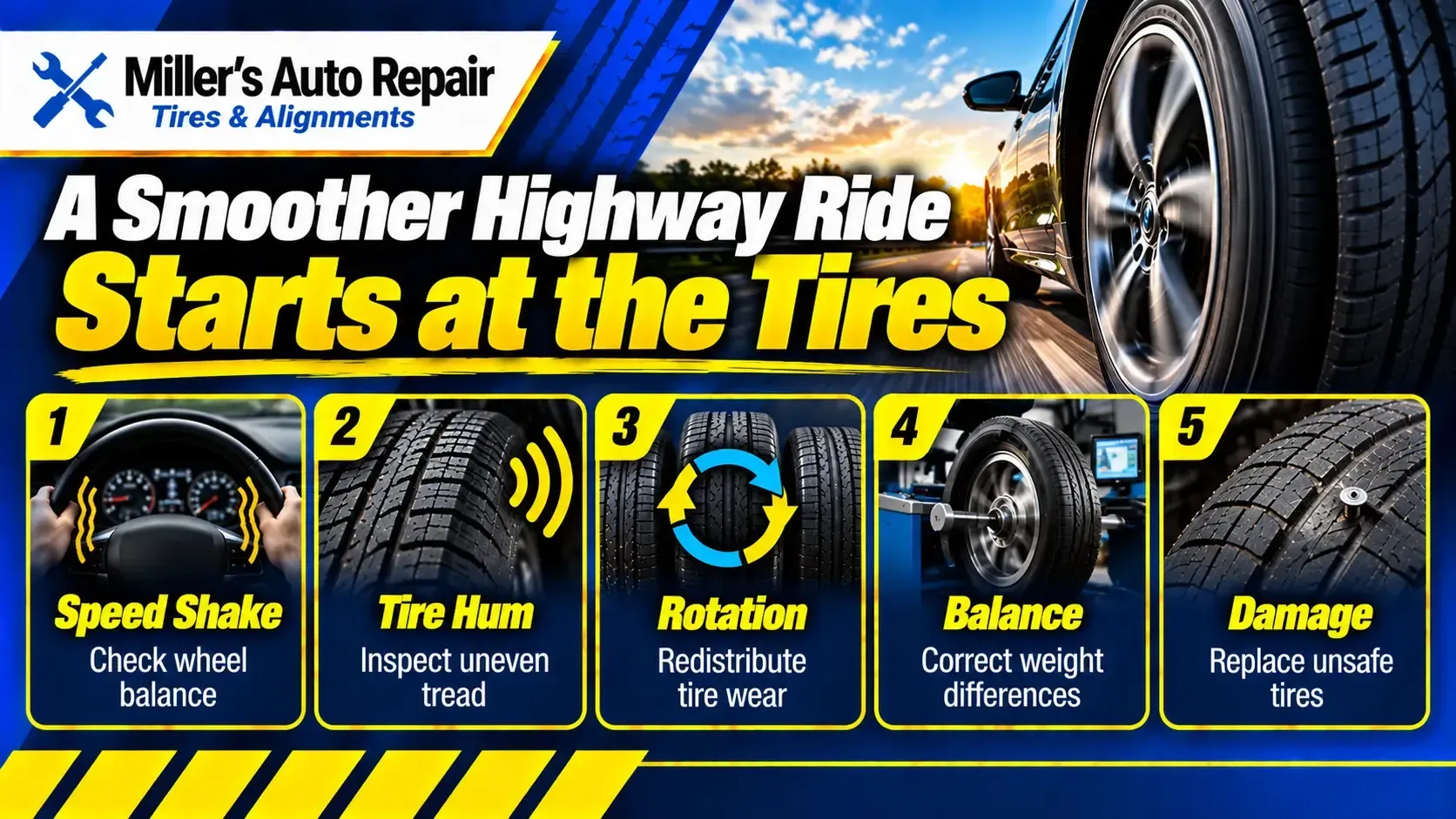
How Tire Rotation and Balancing Address Different Problems
Tire rotation and balancing are separate services with different jobs. Rotation changes each tire's position to manage wear, while balancing corrects weight differences in a wheel-and-tire assembly.
What Tire Rotation Can Do
Rotation helps front and rear tires share wear more evenly. Front tires often work harder because they steer, carry braking loads, and may also deliver engine power.
Rotation can slow front-to-rear wear differences. It cannot restore cupped tread, remove a bulge, or repair internal damage. Florida's official tire-care guidance recommends rotation at least every 5,000 miles, while your owner's manual remains the best schedule.
What Wheel Balancing Can Do
Balancing measures how weight is distributed around each wheel and tire. A technician adds or moves small weights so the assembly turns more evenly at speed.
Our road-force wheel balancing process can also reveal stiffness differences or excessive force variation within a tire. That detail matters when a standard balance looks correct, but the highway speed vibration remains.
Read the Pattern in the Ride and Noise
Where you feel the motion and how the sound changes provide useful clues. We still inspect the vehicle because different faults can produce similar symptoms.
Steering-Wheel Shake or Seat Vibration
A shake concentrated in the steering wheel often points toward a front wheel or tire. Motion felt mainly through the seat or floor may come from a rear assembly, although the pattern is not a final diagnosis.
A lost wheel weight, tire flat spot, bent rim, or road-force variation can create speed-related movement. Our Chevrolet repair page covers suspension and steering diagnosis for Chevrolet cars, SUVs, and trucks.
Humming, Thumping, or Cupped Tread
Noisy tires at highway speed often have uneven tread blocks that strike the road in a repeating pattern. Cupping may sound like a hum or roar that grows with speed, while a separated belt may cause a repeating thump and visible tire distortion.
Wheel bearings can also hum, with sound that may change during a gentle turn. Worn shocks or struts can cause scalloped wear. Rotation may move the sound, but it will not erase damaged tread.
When Rotation and Balancing Will Not Be Enough
Rotation and balancing will not correct every bumpy or noisy ride. Uneven wear across the inner or outer edge may call for a wheel alignment check, especially after a pothole or curb impact on Blanding Boulevard.
A tire with a sidewall bulge, exposed cord, deep cut, or suspected belt separation needs replacement rather than continued rotation. Persistent bouncing may require shock or strut repair. Grinding, looseness, or a hum that changes with steering load may point to a wheel bearing or another chassis part.
Reduce speed and stop in a safe place if a new shake becomes severe, the vehicle pulls sharply, or a tire loses pressure. Driving farther can make a damaged tire or loose wheel less predictable.
What We Check Before Recommending Service
Diagnosis starts with the symptom, its speed range, and whether it changes while turning, braking, or accelerating. We then check cold pressure, tread, sidewalls, wheel condition, and lug-nut torque.
For a tire rotation in Orange Park, FL, we also confirm the correct pattern for directional tires and follow manufacturer specifications. When balancing is appropriate, we measure each assembly instead of assuming that rotation alone will remove the shake.
We document whether the next step is rotation, balancing, alignment, suspension work, or tire replacement. We match the service to the confirmed cause and explain what can wait.
Takeaways
A speed-related shake often makes wheel balance a sensible first check, while growing tire noise can point to uneven wear or damage. Rotation manages wear among tire positions, and balancing corrects weight differences, so one service does not replace the other.
Note the speed, sound, and location of the symptom before your visit. Those details, combined with a tire and chassis inspection, help identify the right repair without guessing.
Frequently Asked Questions
Can unbalanced tires make my car feel bumpy?
Yes, unbalanced tires can make a car feel bumpy or shaky, especially within a certain highway-speed range. A bent wheel, damaged tire, flat spot, or suspension fault can feel similar, so the wheel-and-tire assembly should be inspected and measured.
Will a tire rotation stop highway noise?
Not always. A tire rotation may change or reduce noise when the cause is an early, position-related wear pattern. It will not restore cupped tread or fix a damaged tire, worn wheel bearing, or failed suspension part.
How often should tires be rotated and balanced?
Florida tire-care guidance recommends rotating tires at least every 5,000 miles, though your vehicle or tire maker's schedule comes first. Balancing is usually performed when vibration appears, after tire installation or repair, or when inspection and measurements show it is needed.
Why does my steering wheel shake only at certain speeds?
A steering wheel may shake only at certain speeds because wheel imbalance becomes most noticeable within a specific rotation range. Tire damage, a bent rim, brake concerns, or loose steering and suspension parts can also create speed-sensitive movement.
Is it safe to drive with a new tire vibration or noise?
Only with caution, and only for a mild symptom. Stop driving when safe if you notice severe shaking, pressure loss, a bulge, or exposed cord. Otherwise, reduce speed, avoid sudden maneuvers, and arrange an inspection before returning to highway travel.
Schedule Tire Rotation and Balancing in Orange Park
If your tires become rough, loud, or shaky on I-295, US-17, or another Clay County route, contact our team at Miller's Automotive for an inspection. We will check the tire and wheel assemblies, explain the cause, and recommend rotation, balancing, or the related service the vehicle actually needs.
Call
(904) 364-9499 to schedule, or visit our shop at
1156 Park Ave, Orange Park, FL 32073.
Edward Jay "Ted" Miller
Edward Jay "Ted" Miller is the founder and owner of Miller's Automotive in Orange Park, Florida, where he also serves as shop manager and lead technician. A lifelong Floridian raised in Orange Park, he has spent more than 35 years in the trade.
Ted started at Middleburg High School, completing three years of automotive mechanics training while actively participating in local car and motorcycle events. He came up as a tire and lube technician, then worked at Jim Martin Tires, Saturn of Orange Park, Firestone, and Goodyear, servicing domestic and import vehicles daily. He opened Miller's Automotive in 2008. Now an ASE-certified automotive technician, he still turns wrenches on brake repair and engine diagnostics for Toyota and other domestic and Asian vehicles.
Those years on the floor shaped how he runs the shop. Miller’s Automotive backs every repair with a one-year labor warranty. Ted has followed the same rule since 2008: repair each vehicle as if it belonged to family and recommend only the work it needs. Drivers looking for an auto repair shop in Orange Park, FL, get that same standard.
