
Discover More On:
Signs Your Timing Belt Is About to Fail and What to Do Next
Browse by Repair
The signs of a failing timing belt can be subtle, and some belts break without a clear warning. Ticking or chirping, rough running, fluid near the timing cover, and a no-start condition can point to trouble. At Miller's Automotive, our timing belt replacement process includes checking the belt, tensioner, pulleys, and related parts before we recommend work.
Why Timing Belts Can Fail With Little Warning
A timing belt keeps the camshaft and crankshaft synchronized so the engine's valves and pistons move in the correct sequence. The belt sits behind a cover, so you usually cannot check it during a quick look under the hood.
Some belts show cracks, glazing, missing teeth, or contamination before failure. Others weaken internally and still look acceptable from the visible side. A worn tensioner, seized pulley, oil leak, or water pump problem can also damage the belt.
If the belt slips or breaks on an interference engine, the pistons may strike open valves. The result can be bent valves, piston damage, or cylinder-head repairs. This risk is why
factory-recommended maintenance matters even when the engine seems to run normally.
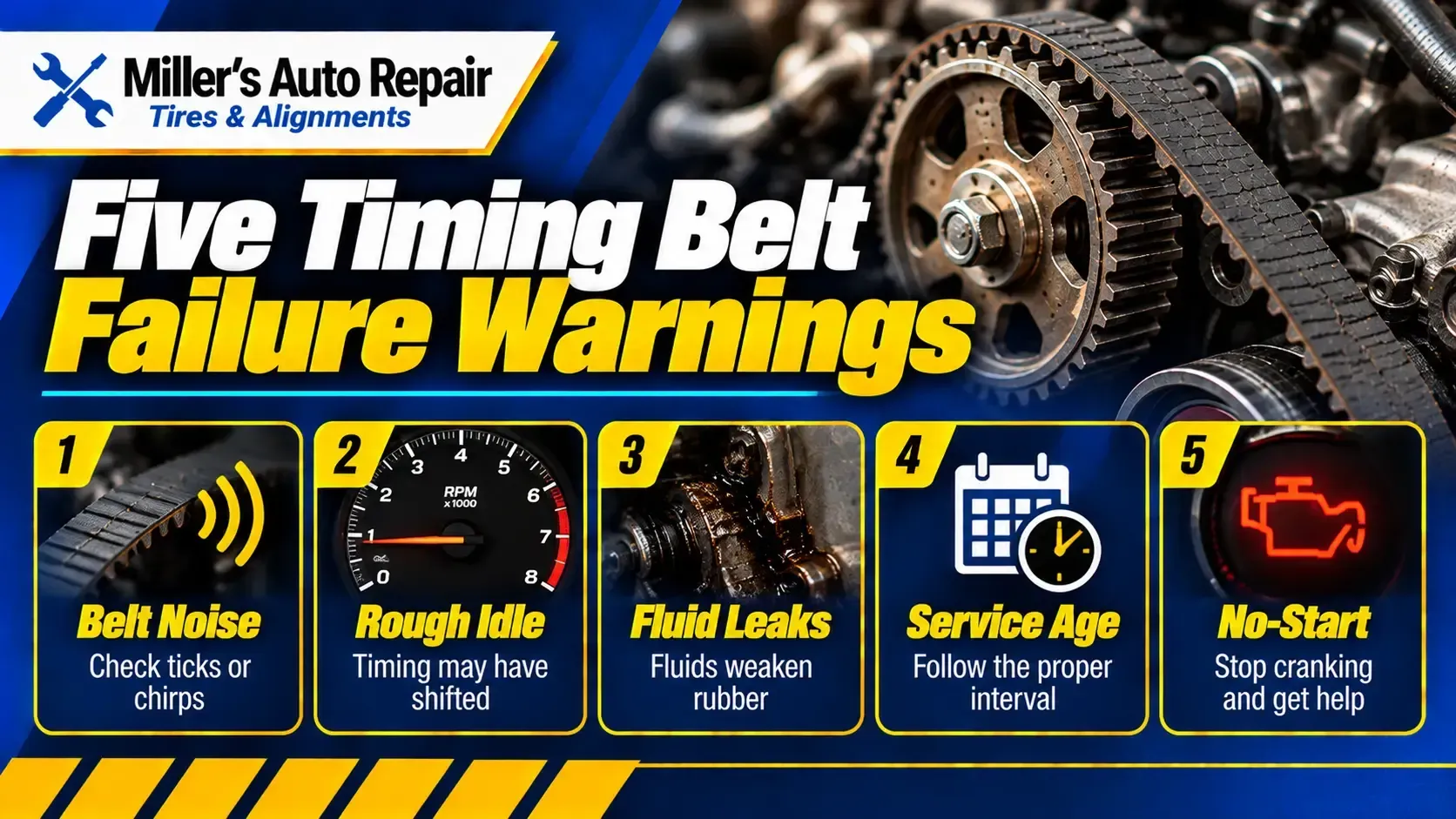
Signs of a Failing Timing Belt You Should Not Ignore
Common timing belt warning signs include unusual front-engine noise, changes in how the engine runs, and leaks around the timing cover. These symptoms do not prove that the belt is bad, but they justify an inspection before more driving.
Ticking or Chirping From the Front of the Engine
A repeated tick or chirp near the timing cover may come from a worn tensioner or pulley bearing. It may be most noticeable during a cold start.
Several other engine accessories can make similar noises. A technician must locate the sound and inspect the timing components before identifying the cause. Do not remove a timing cover while the engine is running.
Rough Running, Misfires, or Loss of Power
An engine may run roughly, misfire, or lose power if a worn belt jumps one or more teeth. The shift changes valve timing, which can also turn on the check engine light.
These symptoms also occur with ignition, fuel, and sensor faults. Testing can compare camshaft and crankshaft signals to determine whether mechanical timing moved.
Oil or Coolant Near the Timing Cover
Oil or coolant near the timing cover can shorten belt life and may signal a failing seal or water pump. Fluid can soften the belt material, affect tooth grip, and collect dirt inside the cover.
A coolant leak may also come from another part of the system. Our cooling system repair service uses inspection and pressure testing to locate the source before parts are replaced.
An Engine That Cranks but Will Not Start
An engine that suddenly cranks faster than usual but will not start may have lost compression after the belt broke or jumped. This symptom can mean the failure has already occurred.
Stop cranking the engine and arrange a tow. Repeated attempts may move damaged parts again, especially on an interference engine. Compression testing and a timing inspection can confirm what happened.
When Mileage and Belt Condition Matter
The safest guide for when to replace a timing belt is the interval listed for your vehicle's exact year, make, model, and engine. Waiting for symptoms is risky because a belt may reach the end of its service life without making noise.
Check the Manufacturer's Replacement Interval
Many replacement intervals fall between 60,000 and 105,000 miles, but the correct figure varies by vehicle. Time may also matter. Check the owner's manual and service records instead of relying on a general rule.
If the maintenance history is missing, treat the belt's age as unknown. Orange Park heat, repeated Jacksonville-area traffic, and long runs on US-17 or I-295 add heat cycles and operating hours even when mileage grows slowly. FLHSMV also encourages drivers to keep a road-ready vehicle well serviced before travel.
Let a Technician Inspect the Covered Components
A proper inspection may require removing an upper cover and checking the tensioner, pulley bearings, seals, and water pump. Missing teeth, frayed edges, glazing, fluid contamination, or incorrect tension can support a replacement recommendation.
Vehicle design matters as well. Our shop services domestic and imported models, including vehicles covered by our Honda repair and maintenance work. The engine code, not the badge alone, determines whether a vehicle uses a belt or chain and which interval applies.
What to Do if You Notice a Warning Sign
Reduce driving and schedule an inspection for a new timing-cover noise, leak, or sudden change in performance. Shut the engine off if the noise worsens, power drops, or it cranks without starting.
Do not assume every tick means the timing belt is failing. The Miller's Automotive team reviews the symptoms, mileage, history, and inspection findings before recommending a repair. During timing belt replacement in Orange Park, FL, we also check whether the water pump, tensioner, pulleys, and seals need service.
Takeaways
Because a timing belt may fail with few or no symptoms, the manufacturer's interval and service history are your strongest guides. Ticking or chirping, rough running, leaks near the timing cover, and a sudden no-start condition call for a prompt inspection.
If you notice a warning sign, limit driving and have the system inspected. Replacing a worn belt and related parts before failure can reduce the risk of major internal engine damage.
Frequently Asked Questions
Can a timing belt fail without warning?
Yes, a timing belt can fail without an obvious warning. Some belts weaken internally or lose teeth while the visible surface still looks acceptable, so scheduled replacement remains important.
How long do timing belts usually last?
Timing belts often have replacement intervals between 60,000 and 105,000 miles. Your vehicle's owner's manual and engine-specific service schedule provide the correct mileage and time limits.
Can I drive with a noisy timing belt?
Only for short, necessary trips until a new timing-cover noise is inspected. A worn tensioner or pulley can damage the belt and lead to sudden failure. Stop driving and arrange a tow if the engine runs roughly, loses power, or cranks without starting.
Is a timing belt the same as a serpentine belt?
No, a timing belt is not the same as a serpentine belt. The timing belt synchronizes internal engine parts, while the serpentine belt drives accessories such as the alternator and AC compressor.
Should the water pump be replaced with the timing belt?
Often, yes. The water pump is commonly replaced with the timing belt when the belt drives it or both parts share the same labor access. The correct choice depends on the engine design, pump condition, and manufacturer's procedure.
Schedule Timing Belt Replacement in Orange Park
If your timing belt is overdue or you notice a possible warning sign, contact Miller's Automotive for an inspection. We will review the service interval, document what we find, and explain which parts need attention before work begins.
Call
(904) 364-9499 to schedule service at
1156 Park Ave, Orange Park, FL 32073. Our Park Avenue shop serves drivers from Orange Park, Fleming Island, Middleburg, Oakleaf, Lakeside, Green Cove Springs, and nearby Jacksonville communities.

Edward Jay "Ted" Miller
Edward Jay "Ted" Miller is the founder and owner of Miller's Automotive in Orange Park, Florida, where he also serves as shop manager and lead technician. A lifelong Floridian raised in Orange Park, he has spent more than 35 years in the trade.
Ted started at Middleburg High School, completing three years of automotive mechanics training while actively participating in local car and motorcycle events. He came up as a tire and lube technician, then worked at Jim Martin Tires, Saturn of Orange Park, Firestone, and Goodyear, servicing domestic and import vehicles daily. He opened Miller's Automotive in 2008. Now an ASE-certified automotive technician, he still turns wrenches on brake repair and engine diagnostics for Toyota and other domestic and Asian vehicles.
Those years on the floor shaped how he runs the shop. Miller’s Automotive backs every repair with a one-year labor warranty. Ted has followed the same rule since 2008: repair each vehicle as if it belonged to family and recommend only the work it needs. Drivers looking for an auto repair shop in Orange Park, FL, get that same standard.
